Hardware

Optimal number of threads

This brief analysis aims to determine the optimal number of AsterStudy execution threads to use for a structural FEM simulation on one of our computing workstations. Subsequently, we will be able to compare different computing workstations and observe how hardware capabilities have evolved.

We have selected a quasi-static, non-linear (large-displacement) computational model, for which we have defined two meshes. The simulations are performed using Code_Aster. Our computing workstation is equipped with an AMD Ryzen processor featuring 32 logical cores (corresponding to 16 physical cores).

Geometry

We are focusing on a small conical spring (typically used in push-buttons) that will undergo compressive deformation. This geometry also provides an opportunity to test the design functions included in Salome-Meca (Shaper and Geometry) for creating a conical helix. This step could be the subject of a short video; there are already some interesting aspects to explore in this exercise.

The bottom and top sections of the helix are flat, allowing the spring to rest on a planar surface and be securely attached at its ends.

The dimensions are as follows:
- Total height = 10 mm
- Base diameter = 10 mm
- Top diameter = 2.5 mm
- Wire diameter = 1 mm
- Number of turns = 3
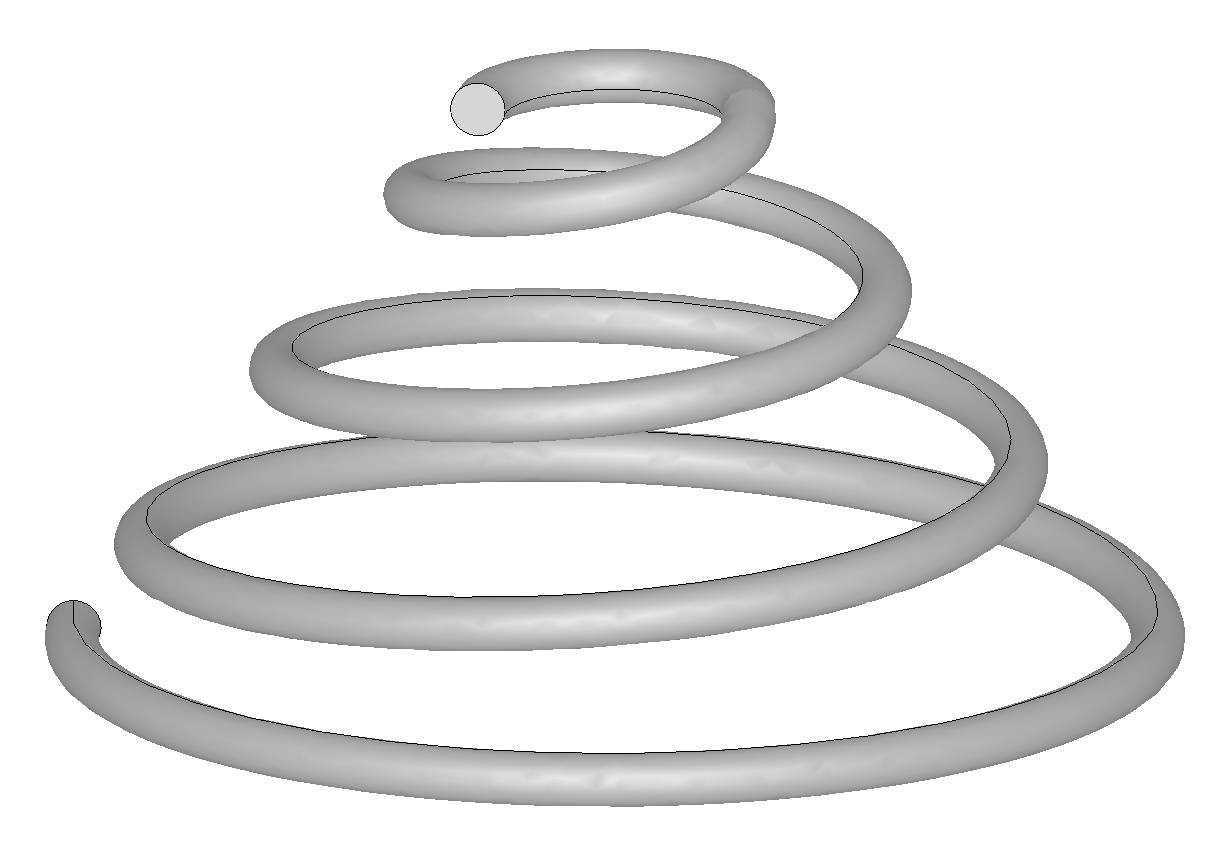
Géométrie du ressort conique
Geometry of the conical spring, generated with the Geometry module from Salomé Méca. The pipe function was used along of a path created using a Python script.
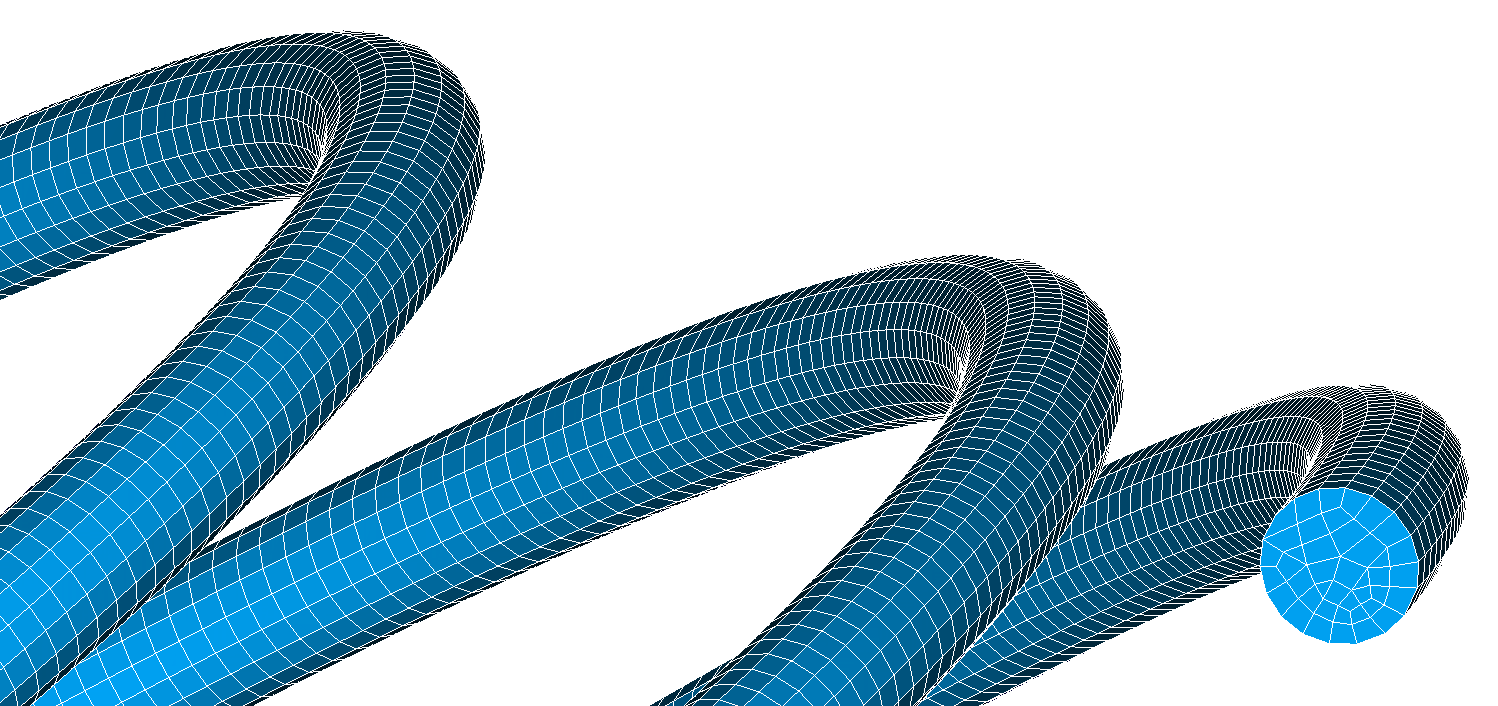
Géométrie du ressort conique
Meshes supporting first-order elements in a first version, and second-order elements in a second version.

Meshes

We have defined two quad-dominated meshes: one with first-order elements and the other with second-order elements.

Number of nodes:
- Mesh 1: 53,122
- Mesh 2: 382,121

Material

The material used for the model is AISI 302 (X10CrNi18-8) steel, hardened by cold working—an alloy commonly used for the manufacture of small springs

Boundary conditions and loads

All nodes in the bottom section of the spring are fixed in the X, Y, and Z directions, while a 3 mm displacement is applied to the nodes in the top section.

The load is applied in 20 successive steps.

Resolution

Initially, the calculation is performed using the linear solver MECA_STATIQUE to verify that the model is correctly defined. Subsequently, the calculation is carried out using the non-linear operator STAT_NON_LINE in order to account for large displacements.

The simulation consists of two stages: the first employs first-order elements (mesh 1), while the second uses second-order elements (mesh 2). During post-processing, the equivalent Von Mises stresses are derived, and their evolution across the 20 quasi-static steps is visualized using a unified scale.


Evolution of the geometry and Von Mises stresses over the 20 calculation steps during compression.


Computation time as a function of the number of threads used

The same calculation is performed using 16, 12, 8, 4, and 1 thread(s), followed by 20, 24, 28, 30, and 32.

The overall computation time, as well as the details of the various stages, is provided in the log file from the Code_Aster module integrated into Salomé-Meca (referred to as AsterStudy).

Explanations

Physical cores – The actual computing units of a processor; they can execute operations independently of one another.

Logical cores – Through technologies such as Intel’s Hyper-Threading or AMD’s SMT, a single physical core can present two logical processors to the operating system.

Code_Aster threads – Threads of execution that a calculation can utilize in parallel. Their efficiency depends on the algorithms employed, the numerical libraries used, and the extent to which the calculation can be parallelized.

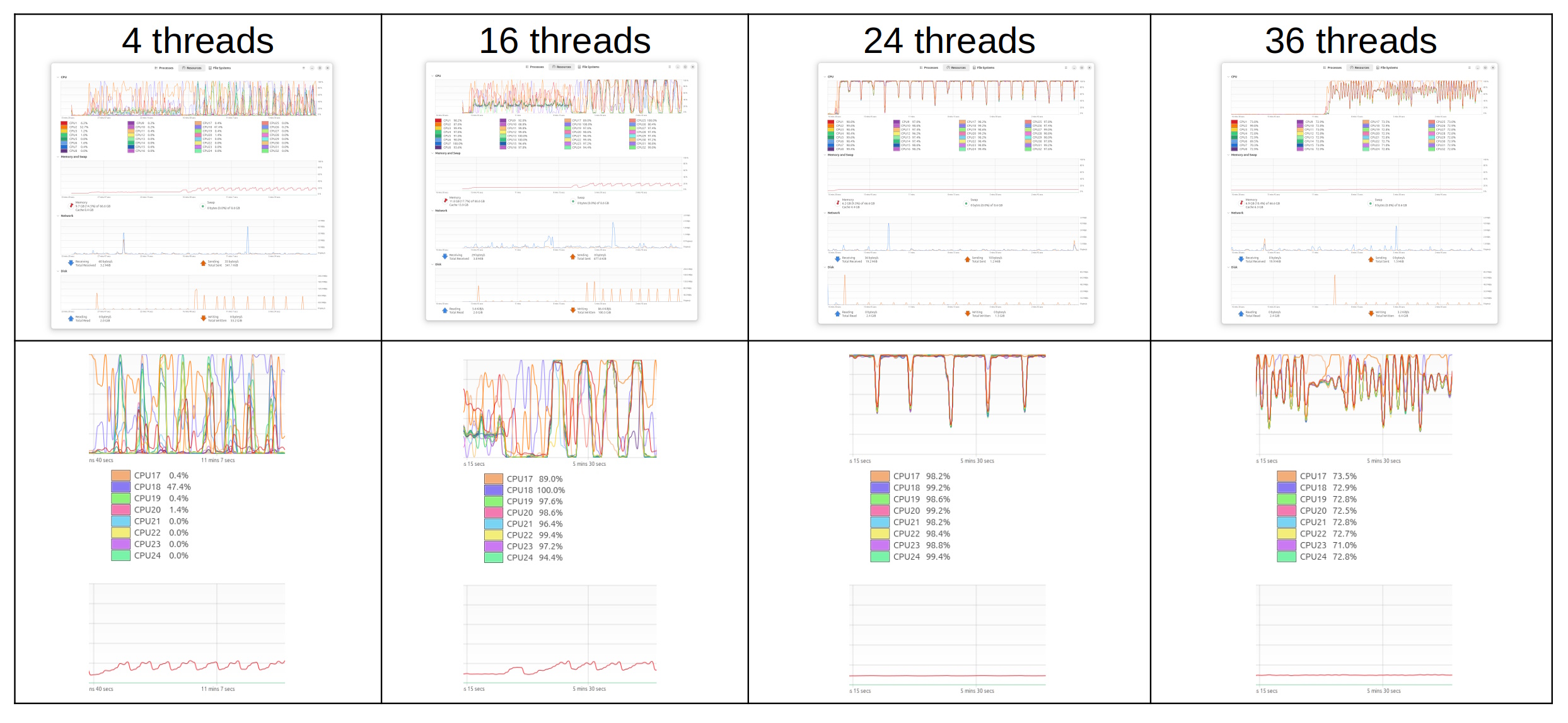
Ubuntu System Monitor

Ubuntu System Monitor

Activity of logical cores as a function of the number of threads specified in the AsterStudy calculation settings.


Adresse:
SIMeka Sàrl
Av. Edouard-Dapples 40
CH-1006 Lausanne


© 2025/2026 - SIMeka Sàrl - Legal notice


EN | FR